Featured Post

The Butbut tribe's Exodus

The Butbut Tribe’s Exodus: Surviving in a foreign land June 22, 2014  in  Cordillera ,  indigenous  by  patnugot By ALMA B. SINUMLAG ...

Thursday, October 6, 2016

DICT: Another White Elephant

Department of Science and Technology Sec. Mario Montejo: "We may no longer need a Department of ICT." 
Source: InterAksyon.com

While Congress is snail-paced in passing the Freedom of Information (FOI) Bill, they approved the in a snap of a finger a law that will create another department for information and communications and technology. This department is called Department of Information Communications Technology (DICT). While it was lined up in the agenda of Congress, it did not get the attention of the media and the people themselves. It seems like it was hideously passed and signed into a law by the legislative and executive branches of our government. Now, questions continue to hound the creation of a separate department for ICT. Is it really one of the priorities that our government should be spending money for?

In creating the DICT, it renamed the Department of Transportation and Communication (DOTC) as Department of Transportation (DOT). Coloma as cited by Sabillo (2016) mentioned that some agencies will be abolished and transferred to DICT. The agencies include Information and Communications Technology Office (ICTO), National Computer Center (NCC), National Computer Institute (NCI), Telecommunications Office (TELOF), and National Telecommunications Training Institute (NTTI). The said department is headed by a Secretary which joins the presidential cabinet. It also has 3 undersecretaries and and 4 assistance secretaries. On a positive note, it is good to streamline the functions of government agencies to avoid redundant functions. The agencies mentioned have actually almost similar functions and it should not just be transferred to the DICT but they should be reconsidered.
 
Source: newsflash.org 

Some government officials have have been expressing disappointment with the department’s creation. As cited in a news article written by Helen Macasaet, “we are already doing a lot of ICT in our respective departments and we know what to do. So there really is no need for another department which can just add unnecessarily to the expenses of the government machinery.” This is a common sentiment that I would also like to pose. The ICT work can be done by the Department of Science and Technology or the Department of Transportation and Communication. They have huge ICT work and it only needs centralism. It is not surprising that sentiments like there were vested interests that hound the bill to be passed to easily.

Compared to the DICT, there are a lot of bills in Congress that are collecting dust but they are of great importance. The Freedom of Information Bill that will implement our constitutional rights to FOI. This bill was dilly dallied by Congress during the previous administration until time lapsed and was archived. Groups had been lobbying for the FOI to be a law. It has been a noisy ride but it did not reach its destination unlike the DICT.

For the farmers sector that is still the majority of country’s population, there has not been a law passed that significantly favoring their plights. The Genuine Agrarian Reform Bill (GARB) is already more than 10 years in Congress and it is junk every time it is filed. The People’s Mining Bill which was filed in 2010 did not get any merit in the House of Representatives because our leaders do not want to repeal the existing Mining Act which is the Mining Act of 1995. For me, for our country to develop and stand on its own, we need a law like the People’s Mining Bill wherein our mineral resources will not be plundered by big foreign mining firms. These are only few among the tons of significant bills filed which are the concerns of the basic sectors of our country. These laws were however archived or deliberately set aside by landlords and big businessmen who are lording in the Philippine politics.

Interestingly, DICT’s declaration of policy is vague. In the first point, it says, “to recognize the vital role of information and communication in nation building” (R.A. 10844, 2015). It is as if saying that country did not recognize the role of ICT before the enactment of this law. More than recognizing the role of information and communication in nation building, I think it is more important to stress the people’s access to public information which will advance people’s participation in nation building. The first statement alone in the declaration of policy is not a music to my ears and to the ears of many critics of this law.

The purpose of the law is not well articulated in the declaration of policy. After reading the first statement which for me was vague, I was more confused on the next statements. I did not really understood what the law meant by “to ensure the provision of strategic, cost-efficient, citizen-centric information and communications technology (ICT), infrastructure, systems and resources as instruments of good governance and global competitiveness.” Aside from its vagueness, I cannot visualize how the said declaration will be actualized.

After reading all the points in the declaration of policy, I was not convinced that this country that is in poverty and political turmoil needs this department. I cannot stop myself in concluding that the DICT was only created to siphon more money from the peoples coffer. It happened at the National Anti Poverty Commission (NAPC) during the previous administration. Recently, it was found out that NAPC has included in its payroll hundreds of consultants who monthly received a salary ranging from Php 25,000 to Php 500,000. It was a scandal that was only found out recently with the change of administration. The DICT was railroaded by the people who are close to the previous president namely, Herminio Coloma.

I don’t think that our country become globally competitive with the setting up of DICT. I cannot see the logic of having a department that will only focus on what the other departments have been doing as part of their mandate will accelerate nation building. I share the sentiment of the DOST that line agencies have been doing ICT work for quite long and the country is doing fine. I do not see how this department will help in the major problem of the Philippines which poverty and underdevelopment.

When the bill was approved in the Senate during its third and final reading, Senator Drillon mentioned in an article written by Gonzales (2015), “the measure addresses the need for the Philippines to be at par with other ASEAN economies which have cabinet level departments for their information and communications technology (ICT).” The thing is, our leaders see development in an outward manner. What matters to them is how the Philippines gets across other countries. Instead of resolving the dire situation in the domestic that will propel the economy, they pass policies like the DICT to impress regional and international organizations like the ASEAN. Our country cannot afford anymore to spend much money on unnecessary things. We do not need to look good in the outside but rots in the inside. Like the sentiment mentioned in the article written by Macasaet (2012), it says, “We don’t have enough resources to spend in ICT, that’s why we cannot budget much for it. It is too expensive. And our people are not ready to do it. Some just don’t want to take it. There are other more important things to prioritize like food and electricity.”
I would like to point out some of the sentiments in 2012 that I think were not addressed when the law was railroaded in Congress and finally, when it was signed into by former president Benigno Aquino III. Below are the sentiments that I share up until today.

“There are political tones to the DICT creation. There are Cabinet members who do not see eye to eye on several matters and the ICTO will neutralize those people in the Cabinet. What happens is if a DICT is created, it can land on a Cabinet secretary who is presently already so influential with the President. What with another department in his influence?” (Macasaet “DICT: Is it really Necessary for Transformation?”)

“No amount of ICT can eliminate corruption. What we need is just the right leadership and taking out all the corrupt officials and not voting for them again! There are still quite a number of those corrupt officials who just don’t like ICT because they cannot continue with their old ways” (Macasaet “DICT: Is it really Necessary for Transformation?). Moreover, what the government needs to do is empower its manpower on ICT. Putting up a cabinet level department is like putting ICT as one of the country’s pressing concern when in fact, there is only a need to systematize the ICT work without setting up a new department. Putting up a system which will tie all the ICT work of the government units and agencies using the existing manpower and running resources is the smartest thing to do especially in this era where spending less but gaining higher impact is the language.

I would also agree on a sentiment of a fellow Filipino that says, “I think we need help from those countries whose ICT organizations have already proven to be successful like Singapore. Maybe we should get advice from them on how we should structure our ICT department in the Philippines, instead of just creating a DICT right away.” Aside from the fact that it is not one among the priorities of the government, setting up the department right away is shocking. It is like creating a white elephant which is actually a trend in the government projects.

To cite a local example of a white elephant, the huge building called BAPTC which is a concern among the farmers of Benguet because instead of decreasing the farmers’ burden, it has only pressed another burden by adding fees into almost everything. Thus, the old trading post is still preferred. This only shows that farmers are not ready for an advance trading system because their major problem which is the relations of productions is not stripped off. The new trading system, although promising, is not yet fit in their present situation.

It is like the DICT. It is a white elephant because the government invested resources including manpower to it but it is not an appropriate solution to whatever it is that the country is facing.

Moreover, some people do not really care for this law. When they were asked in 2012, they said, they do not care and they wanted to leave the issue on the IT experts. This is one evidence that it is not a mass issue. It is not the concern of majority of the Filipinos. There concern is mostly on what to eat for the next meal and if their rights are being recognized.

Contemplating on the passing of the DICT into a law leads me into a suspicion that the law is all about business. When this bill was still being lobbied in Congress, the support came mostly from the private sector. It seems that the business sector sees a lot of opportunity in tying up with the government on ICT related investments. Today, the appointed secretary who sets in the President’s cabinet is a former executive of Globe Telecommunications. Now, it is crystal clear that the smooth passage of the law is a “business as usual.” What is now the assurance that our information and communications technology will not be controlled by corporations? I can sense a brewing deregulation of one of the government’s service which is communications.

I want to reiterate that what the government needs to look into is the snail paced Freedom of Information Bill not a law that uses the peoples’ coffer in advancing the interests of business institutions.

Works Cited
Gonzales, Yuji. “Senate OKs bill creating ICT department.” Philippine Daily Inquirer, 2 Jun. 2015. Web. 30 Sept. 2016.
Macasaet, Helen. “DICT: Is it really necessary for PH transformation?” Philippine Daily Inquirer, 6 Aug. 2012. Web. 30 Sept. 2016.
Philippine Congress. “Republic Act No. 10844. An Act Creating the Department of Information and Communications Technology, Defining its Powers and Functions Appropriating Therefor, and other Purposes.” Official Gazette of the Republic of the Philippines, 23 May 2016. Web. 30 Sept. 2016.
Sabillo, Kristine Angeli. “Dep’t of Information and Communications Technology created.” Philippine Daily Inquirer, 23 May 2016. Web. 30 Sept. 2016.
Somosot, Janice. “5 Things To Know About the DICT Act Of 2015 Signed Into Law By President Aquino.” Times, 24 May 2016. Web. 30 Sept. 2016.

Curtailing the Freedom of Information

Source: asianjournal.com 

On July 23, 2016, the newly elected president of the Republic of the Philippines signed an Executive Order implementing the freedom of information across the executive branch of the government. This is one of the shining moments of Duterte as he assumed post. The former president Benigno Aquino III in his six (6) years in power did not lift a pen in advancing one of the crucial pillars of democracy, the freedom of information.

The Power of Access
Mendoza (2015) mentioned in an article that access to information in the experience of the Philippines has helped greatly in filing graft and corruption cases against two presidents and one Supreme Court Chief Justice. Policies compelling access to public documents has revealed several cases of graft and corruption committed by public officials. The mandatory yearly declaration public officials’ assets and liabilities has sealed some of the leaks for corruption.

Peoples’ access to public records especially when it comes to the use of the peoples’ money and transactions that government and its leaders enter empowers the people by becoming part of the check and balance. It gives them the power to make public officials accountable for their wrongdoing. On the other hand, access can also mean danger. People’s power of access can endanger a nation and its citizens if system is not in place.

What is lacking in the Philippines with access
Some people would brush off the idea of having a specific law on the freedom of information. This is because the country has several policies on access to information. We have the Anti Graft and Corrupt Practices Act which compels public officials to disclose all their assets. Mendoza (2015) mentioned that in 1989, Congress passed a law that allowed the public to have copies of the declared assets and liabilities public officials.

Moreover, peoples’ right to access public documents is enshrined in the Philippine Constitution even way back 1973. It was only polished in the 1987 Constitution after the toppling of the Marcos dictatorship.

In the code of ethics of government officials, it mandates public servants for full disclosure policy. Aside from their assets and liabilities, it compels every unit of government to be transparent on all transactions including budget and project documents. In fact in every transaction, there are processes to be undertaken like the bidding and all. The processes should also be made public. In local government units and agencies, they are regularly posting their budget and where it was used.  

At the international arena, the Philippines seems to be in good standing when it comes to freedom of information.

What is then the need for the Freedom of Information Act? The Bill has been filed In the Sixteenth Congress but it only reached an approval on the 3rd Reading by the Senate and the Congress ended. What is with the snail-paced movement in Congress on the FOI if this is really one of the pillars of democracy? Are the policies enough that Philippines does not need a separate implementation of our Constitutional right to freedom of information?

The Access to Information at Work
Every Filipino citizen has the constitutional right to access public documents that do not endanger its international relations and may not harm innocent people. This is enshrined at the Section 7 of Article III or the Bill of Rights. However, on the grounds, it has been difficult to access information from the government offices. Even the media practitioners still need insiders to be able to access information that are of public interest.

With several policies on access to information and disclosure, it has been a culture that government authorities validate the use of information and the integrity of a person who is accessing the information. In the Constitution, the bias should be for the bonafide citizens who are accessing information. It should not be the other way around. The government authorities are required to disclose information at all times when requested unless there is a compelling reason not to.

On the other hand, the full disclosure policy has been crucial making records available for the public. These records which are of importance include government transactions and budget. Yes, it is true that people can now see documents posted in government offices. Budgets are disclosed, bidding process of projects and purchase of equipment are posted. The problem with the system is that, documents posted cannot be understood by people who do not have background on accounting or legislation. In this case, they should not expect that citizens who do not have tertiary diplomas to understand.

There is also a problem in the monitoring process on transparency. In a monitoring process where this writer was a part of the monitoring team, the government tool was shallow. The questionnaire only delve on whether or not the LGU or the government agency has posted religiously important information on their bulletin boards. Supposedly, the principle of transparency is having the information available for the public. When you say information, it should be translated in a way that everybody can understand what the document is saying.

Moreover, when bulletin boards are not enough, government units and agencies should be using barangay assemblies and municipal assemblies to bring information down to the people. In this manner, documents are properly explained in layman’s terms so that everybody understands. It is only when people understood the information that it can help empower them in order to participate. It is only when people participated in promoting transparency that the principle of transparency is achieved. Religious posting of budget line, expenditures, projects and other transactions are meaningless when it cannot get across to its expected audience.

One of the reasons of the Senate in playing dilly-dally on the FOI Bill is a premise that we have enough policies. In actual however, the policies have no fangs. There have not been any government authority to be filed a case on not allowing access to information when in fact, not a single day, a citizen is denied access to public public documents. The FOI Bill compels government authorities to respond to request for access. They can be filed raps when they failed to respond to the request or deny request without any grounds.

In Indonesia, a government authority can be jailed for one year or can be fined of up to five million rupiah for not responding immediately to a request for access especially when the public record is highly needed by a citizen and that it may jeopardize his/her life when denied access of a certain public record.

Setting up of FOI system
Perhaps, Congress is not pushing the Bill forward because of a system to be implemented once the law is passed. In the FOI Bill, a system is needed to be in place for public records to be easily available online and in electronic format. This system is needed to hasten processes. Information that need the approval for access are only those that are confidential.

If the worry of Congress is the backfire of the law by endangering the nation when documents go in the hands of evil minds, there is an important section in the Bill that defines what and what not to be made available to the public. In Section 6 of the FOI Bill, there are 10 items that detailed the exemptions on the public access. One of the exemptions is information that would compromise the internal and external defense, law enforcement, and border control.

With the detailed exemptions, the FOI Bill is actually not so free. The exemptions are rigid. One example is the letter d) of Section 6 that states: “The information requested consists of drafts of orders, resolutions, decisions, memoranda or audit reports by any executive, administrative, regulatory, constitutional, judicial or quasi-judicial body in the exercise of their regulatory, audit and adjudicatory function” (3). There should not be a reason then to dilly-dally the proposed bill.

The Need for the FOI Law
As a constitutional right, it should have an implementing power like other constitutional rights. The policies available on transparency, and accountability are but supplements. There should be a law that has the ability to punish the violators. Yes, it is true that Filipinos need only to invoke their freedom of information because it is already reflected on policies but in cases where government authorities violates the rights of the citizens, are the available policies enough when victims want to file raps?

It is laudable that President Duterte signed an Executive Order implementing the freedom of information across the executive branch. As cited by Almario (2016) the Presidential Communications secretary mentioned: “I surmise that the public will understand that after 29 years of fighting to strengthen this freedom of information, and to strengthen the right to information … Only 25 days as President Rody Duterte -- this is already a record-breaking speed of a cornerstone, a milestone, or a landmark executive order being signed.”

Indeed, it is a milestone in the history of asserting the FOI. This leap forward should be used in investigating how the peoples’ money was managed by the executives in the past administration. It should also be used in keeping an eye on the transactions of local executives.

As a case in point, the people of Kalinga especially those affected with Chevron’s geothermal power project application were not aware of the transactions that the provincial governor and the mayors are getting into. There are rumors spreading that the governor has already given the green light to Chevron despite the strong opposition on the ground. Communities opposed to the project lose hope with this kind of information. This is because there of the lack of transparency. Governor Baac and Chevron in 2012 signed a Memorandum of understanding that people did not know of. With the Executive Order signed by President Duterte, people on the ground should be aware of all the transaction so that they will have the basis to lobby or hold their leaders accountable if they do not represent the voices of the people they should be serving. With the case above, it cannot be discounted that abuses of power related to graft and corruption exists even with the existence of several policies that advances transparency and accountability.

In indigenous communities in the Cordillera that are swarmed by development projects including extractives, the freedom of information is needed not only in the executive branch of the government. As per experience, community folk in Kalinga for example are repeatedly deceived by authorities by not disclosing enough information when it comes to the development projects. Even in the processes of the free, prior and informed consent (FPIC), there are misinformation which is leading the community to an unfavorable situation. People are often divided because of the misinformation. The company and the government agency facilitating, the National Commission on Indigenous Peoples (NCIP) are only sharing the positive effects of the project. Most of the time, the NCIP spread false accusations against the opposition that they are communist or something like that to discredit their position.

The power of true information that should be shared by the government agency empowers the people to make a sound decision. I think this should be the role of the NCIP in facilitating the FPIC processes. They should ensure that indigenous communities understood very well the project. All information both good and bad should be tackled in a way that indigenous community can grasp. If the FOI Bill becomes a law, it can compel government agencies like the NCIP to tell the truth and only but the truth. It will compel them to disclose all transactions that they enter especially with the corporations. Indigenous communities will surely rejoice if there is a law that they can use to make the NCIP officials accountable with their manipulation of peoples’ decision making process by not disclosing the truth.

Lastly, it is saddening that one of the pillars of democracy which is already enshrined in the Constitution cannot be implemented well because the House of Representatives are snail pacing it. It cannot be denied that the government officials who are dragging the pace of the FOI bill have their own self interests. Previously, there were reports that government leaders from the poorest provinces in the country are one of the richest. Well, the freedom of information is in the Constitution to protect the people from the abuse of the government.

Works Cited
Alimario, Anjo. “President Duterte Finally signs FOI.” CNN Philippines Website, 25 Jul. 2016. Web. 25 Sept. 2016.
Bagayaua-Mendoza, Gemma. “Why the Philippines needs a freedom of information law.” Rappler, 4 Aug. 2015. Web. 25 Sept. 2016.
Official Gazette. “Proposed 2013 Freedom of Information Bill. Official Gazette Website. Web. 26 Sept. 2016.

Saturday, June 21, 2014

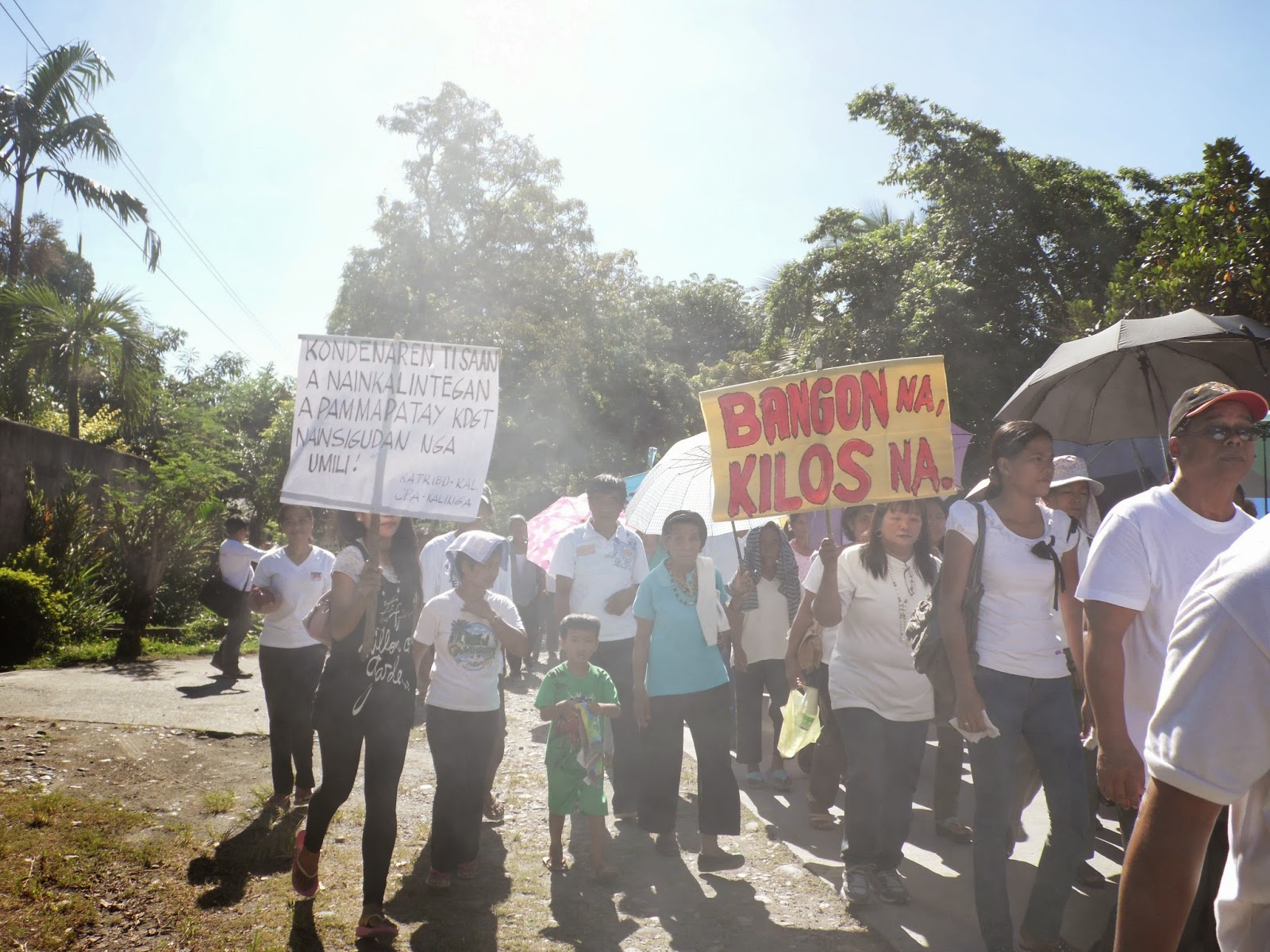
The heartbreaking realities in the Philippine society. Albino Lupnacan, an honest teacher in Kalinga was shot dead last year by a riding in tandem. The photos are taken during the indignation rally sometime in 2013 in the main street of Tabuk City, Kalinga


The Butbut tribe's Exodus

The Butbut Tribe’s Exodus: Surviving in a foreign land

June 22, 2014 in Cordilleraindigenous by patnugot
By ALMA B. SINUMLAG
www.nordis.net
We could have chosen to return to our home in the upland but the terror we experienced was still lingering especially among the women and children. We chose to survive and rebuild our lives and community here, said Ama Banag during their cultural exchange with the Paiwan tribe of Taiwan on April 2013.
The Butbut tribe from Buscalan and Ngibat settled in the grass land in Anonang, Liwan West, Rizal, Kalinga on March 7, 1988 with little cash and no farm tools. The first thing that Ama Banag and other elders did was to build houses for around 60 families. They built the said houses through the practice of innamuju or helping every family to erect a house. All the houses were built after more than a month of collective efforts to finish the first house until the last one. They made use of available resources and materials specially cogon grass and bamboo and a minimal number of trees. For a month, they depended on relief goods from William Claver, the Episcopal Church and other personalities.
On April 1988, after several discussions regarding CPLA’s terror against the Cordillera peoples, the elders lead by the Binodngan Peoples Organization (BPO) which Ama Banag chaired at that time called for the dismantling of the CPLA.
Overcoming terror, rebuilding community
To overcome the terror, the community did not think of going back. They focused on building the community and living their lives anew. But in a barren land, it could not be possible without external help. They informed the Montañosa Research and Development Center (MRDC) of their situation. MRDC is a non government organization that had been working with them for rural development in their villages in Tinglayan. To be able to plant rice and legumes, MRDC gave the community P10,000 to have the grassland plowed by a tractor. This was after they have settled in their houses.
In an interview with Matthew Tauli, Executive Director of MRDC, he recalled that once they received the information, they facilitated relief operations starting June 6, 1988. The food items came from the Church and Department of Social Welfare and Development (DSWD). There were also farm tools from the Montañosa Relief and Rehabilitation Services (MRRS).
MRDC assisted the re-settling community in reforesting the barren land. Fruit trees and many other varieties were planted in the village area and in the pongod (watershed). Their former animal dispersal project in the upland was continued in Anonang. Some villagers, Tauli said, went back in Tinglayan and brought down with them carabaos for the continuation of the dispersal. Today, carabaos are serving as families’ help in the field, food for special occasions and rituals, and for selling during emergency situations.
Since drinking water was scarce, Claver mobilized support for the first unit of water pumps and the next five units came from the Episcopal Church. Moreover, a wind powered water pump was also facilitated by MRDC purposely to relieve the women and children from the hard work of pumping to bring out potable underground water.
The formation of a community organization with the assistance of MRDC and Timpuyog Dagiti Mannalon ti Kalinga (TMK) made it easier for them to access projects for their further adaptation in the foreign land. The Anonang Community Organization (ACO) managed several socio-economic projects like irrigation and water system. Ama Banag mentioned that it had many difficulties in the process but they were able to surpass it through the practice of democratic consultations, community meetings and upholding organizational decisions. Women and youth organizations were set up later in the 1990s. TMK organizers recalled that in 1990, the Anonang Youth Organization was very active in cultural work and were the majority members of Kalinga Cultural Group that presented the province’s situation during the Cordillera Day held in Conner, Apayao.

Continuing the struggle
The Butbut tribe of Anonang may have been dislocated from their ancestral land but their participation in the Cordillera Mass Movement did not stop. Elders like Ama Banag continued campaigning for the dismantling of CPLA and towards the achievement of genuine democracy and self determination. Youth joined the wider Kalinga youth movement. The vibrance of women’s organization cannot be discounted specially on their role in community’s peace keeping and solidarity with other women’s organizations in the province.
Healing scarred relations
The CPLA terror did not only displace them from their ancestral land. For Ama Banag, it destroyed his relationship with his only brother. His brother was the one who made a statement during the height of the CPLA split to kill him because he was just a hindrance to their salary as CPLA. It was a statement that deeply scarred their relationship. One generation has passed but those words were not forgotten. Since their departure from Buscalan, he never talked to his brother and never mentioned his name to his family or to his neighbors. They may see each other in tribal occasions but they never engaged in brotherly conversations since.
Today however, Ama Banag said, his brother realized how wrong he was and is starting to bridge the break he caused. They are now talking in a civil manner but it is a common understanding for both to never mention issues from that horrifying history of the tribe.

Never forget
Today, the elders of Anonang are always telling the young people to know about their history; the history of the exodus that has driven them away from their ancestral land. For the Butbut tribe especially in Buscalan and Ngibat who witnessed that history, it is still unimaginable to forget.
CPLA leadership may have weakened today but the name still sounds evil to them and every time they hear it, history is brought back.
Elders said during their cultural exchanges with the Paiwan tribe of Taiwan in April 2013 that they will never forget until CPLA is totally dismantled and will never be heard; and until genuine justice is achieve for the lives they have taken and for the tribe that has been dislocated from its roots. # nordis.net

Wednesday, June 18, 2014

Drool :) in Chiangmai, Thailand


Kalinga shines in struggle, save the homeland vs corporate plunder

By ALMA SINUMLAG
www.nordis.net
Remember, our grandparents barricaded, lobbied, forged wider unity, sacrificed their lives and took arms to defend this land.
OUT OF OUR LANDS. In Tawang, Balbalan, CEXCI’s mining operations was met with rage by the people because CEXCI came to their community like thieves. Photo by Alma Sinumlag
Remembering the honor
The Kalingas in the Cordillera region have a long history of upholding their community’s honor in the defense of the people’s ancestral domain. When the Chico River was eyed for a series of mega dam projects in the 1970s to 1980s by the Marcos dictatorship and the World Bank, their tribes were never silent.
Regardless of their educational status, they were not intimidated to face government officials up to the national level in the lobby for what they want and bravely presented their dissent to the intrusions in their teritories. Their warrior tradition was reflected in a series of barricades and protests actions. The women fought side by side with men. They dismantled military and National Power Corporation (NPC) tents in Mosimos and carried these to Camp Duyan. They even bared their breasts to shame the army who were serving as NPC’s security guards.
Protest leaders were arrested including Macliing Dulag and imprisoned in Camp Olivas. The resistance was more enflamed when on April 24, 1980, Macliing was gunned down in his home in Bugnay, Tinglayan by state forces led by Lt. Leogardo Adalem. Pedro Dungoc, his neighbor, was also wounded in the same raid but was able to flee and later joined the New Peoples Army (NPA) where he continued to defend the home land, life and resources until his last breath.
Macliing’s death widened the unity of the anti-Chico dams sentiment from Mountain Province to Kalinga. A multilateral bodong was forged with the objective of defending their home land.
The courage of the venerated pangat Ama Lumbaya of the Butbut tribe of Ngibat, Tinglayan took arms to concretize his defense of the ancestral domains. He was a respected elder and a peace pact holder. The resistance in its various forms during this time successfully stopped the project.

Relive the honor
Kalinga Province has not lost its legacy of unity to resist the plunder of their land and resources. It has many vibrant sons and daughters who shall persist against all odds to defend what has been safeguarded by their forebears. This vibrance is now challenged by intensifying entry of ‘development projects’ ranging from mining, geothermal and hydro projects accompanied by widespread militarization.
Markus Bangit and Alyce Claver were killed by state assassins in 2006. The son and daughter of Kalinga who were resolute in the fight for the indigenous peoples’ right to self-determination. They were killed in the state’s aim to silence the protesting masses like they did to Macliing Dulag.
A challenge is then being posed to all i-Kalinga to bring back the honor of the ones who have gone before us by forging a wider and stronger unity against corporate plunder of our ancestral land’s resources. Hear the chant from the Chico River dams struggle, echoing the call to wake the sleeping warriors:
Pasil, Chico, Tanudan
Lumigwat tako losan ay, ay (Let’s all rise)
Ay, ay Salidummay
Ay, ay Salidum-salidummay
Sayang no dik ilaban (It’s a waste if I cannot fight)
Pita un natagoan ay,ay (for the land that has given us life)
Ay, ay salidummay
Ay, ay salidum-salidummay

Yes, the World Bank funded Chico River Dams project during the Marcos dictatorship was stopped but danger is again before us, as many foreign corporations have renewed their interest for minerals, forest, steam, and rivers of the province. The land and resources that have sustained the lives of tribes in Kalinga are threatened of being grabbed from its stewards.
Grabbing our Mt. Binulauan
In the records of the National Commission on Indigenous Peoples (NCIP), nine ancestral domains in the municipalities of Tinglayan, Lubuagan and Pasil, a more or less 26,000 hectare land area is covered by Chevron’s geothermal exploration application. This US based giant corporation is eyeing to set up a geothermal power facility in Mt. Binulauan which is located in the tri-boundary of the three municipalities. It stands 7,641 ft and is classified by the PHILVOLCS as an active volcano with fumarole fields and hot springs on its slopes. One fumarole field is located in Dananao, Tinglayan called Suku-u’ and other two are in Balatoc, Pasil which are the Bu-ot and Bum-bag fumarole fields. Its hot springs are in Tulgao, Tinglayan called by the locals, A-attungan and Western Uma, Lubuagan’s Sun-ot.
Initial findings of Chevron from its exploration activities estimated Binulauan’s geothermal capacity between 120MW to 200MW. Chevron has even announced its timetable of setting up the facility by 2017. Despite a number of documented oppositions from various tribes affected, it has flaunted that it has secured a 100% consent from the indigenous peoples in the area.
In the research activities of the Cordillera Women’s Education Action Research Center (CWEARC) in Uma, Lubuagan; Tulgao, Tinglayan and Dananao, Tinglayan, Chevron violated numerous collective rights of the indigenous peoples. It has employed various tactics including bribery to divide the tribes just to be able to secure the required free, prior and informed consent (FPIC).
In Uma, Lubuagan, the division is highly observable with the rift between the pro and anti. Elders are co-opted and have already given their consent to the company without considering those opposed. In Tulgao and Dananao, the division is starting to cripple their unity. In the interviews made among the members of the tribes, Chevron conducted meetings not only inside their communities but in several hotels in Tabuk City with chosen attendees who are receiving perdiems in the course of the meetings. It was in these hotels that some of the memorandum of agreements (MOA) were drafted and signed.
In the consultations inside the communities facilitated by the NCIP, information divulged to the people are insufficient. The company only stresses that the project would bring development in the province of Kalinga. It has used the government neglect of social services to lure the communities for the project. It promised scholarships, roads, path ways and many others. The absence of such basic services was used to cripple united resistance of communities.
In the evaluation report, however, of the NCIP for the exploration project of Chevron, it pointed out some issues like the non compliance of the company to most of the provisions of the MOA signed with several elders. These issues include scholarships and employment. It mentioned that there were only a few students who were able to avail of the scholarship and instead of giving priority to employing locals, it has hired mostly foreigners.
It is not however unusual for a company like Chevron to violate the rights of i-Kalinga. They did it in Mountain Province, Benguet and Ifugao. They did it in various countries around the Globe. In fact, Global Exchange, an international human rights organization, labeled Chevron as the number 2 most wanted corporate human rights violators in 2012 with Bank of America as number 1. Chevron was listed number 2 in the report for damaging the ecosystem in Ecuador, and repressing protest to oil extraction in Brazil. Its pollution and neglect in the Northern Amazon, human rights abuses in its oil project site in Burma, Thailand and many other cases in North America were not included in Chevron’s sins for ranking number 2 – violator.
With the notoriety of Chevron as a human rights violator, the people of Kalinga cannot afford to give rights to this company to take control over Mt. Binulauan. Binulauan is a common term for the tribes in Kalinga which means gold or precious. This mountain is precious not only for the tribes in the three municipalities but to the whole of Kalinga.
Binulauan houses the watershed supplying numerous creeks that flows down to Pasil and Bonog rivers and unites with the mighty Chico River giving life to the rice paddies along the river banks downstream until Tabuk, considered the rice granary of Kalinga. Tulgao and Dananao tribes have expressed their strong opposition especially when they learned that geothermal facility needs large volumes of water in order to harness more steam from underneath the earth.
Makilala Mining Company
Another burning issue in Kalinga today is mining specially in Pasil where the Batong Buhay Mines once operated but was stopped by communities because of its adverse effects downstream. The renewed interest of mining companies to mine Pasil and other areas in the province started in 2005 with Makilala Mining Company and Cordillera Exploration Incorporated (CEXCI). Since then, it has triggered tension among the communities. It had even caused tribal war due to a triggered boundary dispute.
For some time, the issue was silent until today that Makilala is hell bent at pursuing the project. It covers the ancestral domains of the Colayo, Guina-ang and Balatoc tribes. Exploration activities are ongoing in Balatoc while the processes of FPIC are still being sought from two other tribes.
Recently, the FPIC processes within the ancestral domain of Guina-ang were questioned and found fraudulent. The Guina-ang Indigenous Peoples Organization (GIPO) came out with a manifesto rejecting the mining project because it is in conflict with the tribe’s other source of livelihood, small scale mining. Also, a case has been filed against the NCIP Kalinga because of the irregularities in the FPIC process.
Members of the tribe said NCIP during the consultation was manipulating the process. The Resolution of Consent was drafted by the said agency and community members signed even without a clear understanding of the project. Thus, in the manifesto, they are asking to declare the resolution void.
They also questioned the formation of the council of elders which was facilitated by NCIP. One tribe member said, a council was already in place even prior to the entry of a mining application and that council, he said, represents all the barangays belonging to Guina-ang tribe namely Guinaang, Pugong, Malucsad, Galang, Bagtayan and Dangtalan. NCIP, they said, created a council of elders for them to manipulate the consent.
CEXCI
In Tawang, Balbalan, CEXCI’s mining operations was met with rage by the people because CEXCI came to the community like thieves. The company already started its mining operations even without the conduct of an FPIC process. Tawang people then called for the immediate pull out of the company from their land.
Hydro projects
The story of a “tribe’s resurrection” became a burning issue among the Naneng tribe in Dupag, Tabuk, Kalinga when a Minanga tribe suddenly came into the picture claiming to be initiating the dam project alongsabangan (meeting point) of the Tanudan River and Chico River. Leaders of the Malbong and Naneng tribes said that Minanga was already subsumed long ago into the Naneng tribe.
This project, the Upper Tabuk Hydroelectric Power Project (UTHPP), is implemented by the DPJ Engineers and Consultants. Naneng tribe said that DPJ knows that the majority of the affected communities are opposed to a dam project considering that Dupag people were the ones who dismantled the camps of the NPC during the Chico River Dams project protests. But in the pursuit of this 10MW hydro project, they formed the Minanga ICC with the certification from the NCIP to justify that it was a project initiated by the said cultural group.
The leaders of the Naneng tribe stressed that if you are talking of Minanga today, you are not referring to a tribe or an ICC but a sitio which is part of Dupag. Leticia Bula-at, a feisty woman leader, said that Minanga cannot decide for the fate of Dupag and all that are affected by the project. Their protest reached until Congress and today the project proponents are silent. It is still recorded though in the list of awarded hydro power projects in the Department of Energy as of December 2013.
Aside from the UTHPP, major rivers of Kalinga are blanketed with hydro projects. Pasil River is applied for by PNOC-Renewables Corp with two hydros with a capacity of 22MW and 20MW. The Saltan River in Balbalan is also applied for by the same company with a 24MW hydro project. A 4.32MW mini hydro project of Pan Pacific Renewable Power Phils is eyed along the Chico line in Bugnay, Tinglayan.
Tabuk future a toilet bowl
Tabuk valley is the rice granary of Kalinga. Residents from the upland villages of Kalinga always go down to Tabuk during a rice crisis. Geographically, Tabuk is a valley shaped like a basin. With the applied projects, however, Gloria Pisipis of Innabuyog-Kalinga said the province’s basin will soon become a toilet bowl of corporations. She noted during an interview that people cannot discount the role of the tribes in the lowland Kalinga in the stoppage of the Batong Buhay Mines in the 1980s. Their rice fields were the first to be affected by the silt and chemicals that flowed through Pasil River down to the Chico River. The protest in the lowland was stronger than that in the upland before and that can happen again. She posed a challenge to all i-Kalinga to stand with them in saving the rice granary.

Kalinga shines in struggle
In this year’s celebration of the 19th Kalinga Day, “Kalinga Shine”. The celebration called for a symbolic act of unity by the Call of Thousand Gongs with the participation of all the municipalities from the upland to the lowland. The tribes played a thousand gongs in perfect harmony to the lyrics of Mauricio Patongao’s song entitled “The call of thousand gongs” with a chorus that goes: “I-Kalinga get along, together we are strong. The sound of the gongs reminds me and you that we are all one family”.
It was a very successful activity to bring together tribe members from various communities to play in harmony. The challenge is to transform this symbolic performance into concrete action on the burning issues of the province.
May the sound of the thousand gongs call Hotad to save our homeland from the threats of corporate greed. May the beat of the gongs awaken all the concerned government agencies to heed the calls of the I-Kalinga against projects that run contrary to the tribes’ right to self-determination and progressive development. Only in the unity in struggle to defend our homeland can Kalinga Shine. Let us heed the Hotad and dance together in struggle to save the land which is our life. Imagenordis.net

Refreshing Orchids in the middle of Tabuk City, Kalinga, Philippines


Saturday, December 8, 2012

Sleeping Beauty of Tinglayan


Our Land, Our Life

A documentary film regarding the violations on IP rights in the United States. They are the Western Shoshone People who have been threatened to be pulled out from their ancestral land but they fought and continue fighting for their rights as IPs to be recognized.

First Aid Kit (America)


La Trinidad launches zero waste facility

By ALMA B. SINUMLAG
www.nordis.net
LA TRINIDAD, Benguet — In its program to reduce the garbage problem “not only for today but also garbage problem in the future”, the municipal government here on November 4 launched a 58-million peso zero waste management technology that its fabricator called the “Super Black Hole”.

Brewing coffee the right way

When coffee is great. Experience it with the ones locally producing it. 


Where the roots are found

Bound to Ag-agama, Western Uma, Lubuagan, Kalinga


On the top of the world